
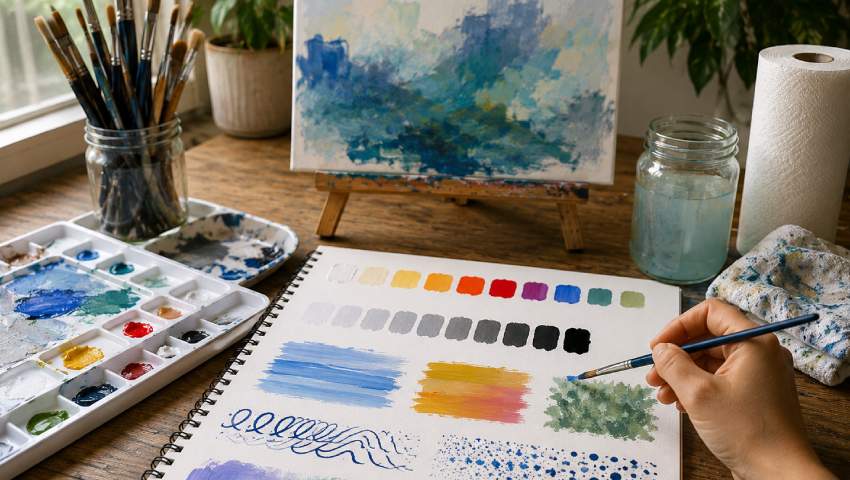
Spend 20–25 minutes total on these drills before tackling a full painting. They loosen your wrist, calibrate your eye for value, and test color mixes without wasting canvas space.
| Exercise | Goal | How to Do It |
|---|---|---|
| 1. Value Gradient Strip | Train your eye to see incremental light‑to‑dark shifts. | Paint a 1 × 6‑inch strip. On the left, pure white; on the right, pure color (e.g., ultramarine blue). Mix four intermediary steps and blend edges while wet. |
| 2. Four‑Color Mix Grid | Learn how base colors interact. | Draw a 2 × 2 grid. In each square, mix two primaries at different ratios (e.g., red‑yellow, yellow‑blue, blue‑red, plus a neutral). Note which combos turn vibrant vs. muddy. |
| 3. Brush‑Stroke Calligraphy | Build muscle memory for pressure control. | With a round brush, paint the alphabet or flowing squiggles in one continuous line, varying pressure from thin to thick strokes. |
| 4. Impasto Dabs | Feel paint thickness and knife control. | Load a palette knife with straight‑from‑tube paint. Apply 10 small dabs in a row, experimenting with angle and pressure to see ridges, peaks, and scrape‑offs. |
| 5. Wet‑on‑Wet Blend Circle | Practice soft edges and color transitions. | Paint a 3‑inch circle of water‑thinned color. Immediately add a second hue to the center and blend outward in a spiral before the first layer dries. |
Pro Tip: Keep a “practice board” (scrap canvas panel) beside your main piece; revisit these drills between layers to stay loose and test mixes on the fly.
Core Acrylic Techniques for Beginners
- Dry‑Brushing
Load a stiff, barely damp brush with a small amount of undiluted paint, then sweep it lightly across the surface. The bristles catch only the raised texture, creating soft highlights, fur effects, or weathered wood grain. - Scumbling
Using a dry, round or filbert brush, scrub semi‑opaque paint in a tight circular motion over a contrasting underlayer. This produces atmospheric haze, distant clouds, or subtle skin tones. - Glazing
Mix a transparent color with 60–80 % gloss or matte medium and brush it over a fully dried layer. The see‑through tint shifts hue or value without obscuring detail—perfect for deepening shadows or warming highlights. - Impasto
Apply paint straight from the tube—or mixed with heavy‑body gel—using a palette knife or a stiff bristle brush. Spread and sculpt peaks 1–3 mm thick to add tactile energy to petals, waves, or abstract strokes. - Wet‑on‑Wet Blending
Pre‑wet the target area with a thin layer of medium, then quickly lay down two or more colors. Blend where they meet using a soft mop brush or gentle cross‑strokes before the 5–10 minute drying window closes. - Masking‑Tape Edges
Burnish painter’s tape along the line you want crisp (e.g., horizon, geometric shape). Paint across the edge, let it reach a “tacky‑but‑not‑fully‑dry” stage (≈ 10 min), then peel tape back at a 45° angle for razor‑sharp borders. - Sgraffito (Scratch‑Through)
While paint is still wet, use the tip of a palette knife, a bamboo skewer, or even the handle of a brush to scrape fine lines that reveal the layer beneath—great for tree branches, hair strands, or intricate patterns. - Pouring & Cells
Combine fluid acrylics with pouring medium (1 : 1 ratio) and add a drop or two of silicone oil. Layer colors in a cup, flip onto canvas, and tilt. Heat‑gun pass briefly to pop bubbles and reveal “cells” for abstract marble effects.
Mastering these eight techniques gives beginners a versatile toolkit—everything from silky gradients to knife‑sculpted textures—so you can tackle virtually any idea on the painting list that follows.